



Getting started with mineral identification made easy
A stone sparkles in the sunlight, feels cool to the touch, and carries a color that captivates instantly. But is it amethyst, fluorite, or perhaps colored glass? The entry into mineral identification doesn't begin with complicated technical terms, but with careful attention. Those who learn to consciously observe natural pieces discover behind every crystal its own story of pressure, time, minerals, and locality.
Identifying minerals doesn't mean you have to name every stone correctly on the first try. It's about reading its characteristics step by step and honestly testing assumptions. That's exactly what turns a beautiful find, a gift, or a new favorite crystal into a personal masterpiece of nature with tangible identity.
Getting Started with Mineral Identification: Look First, Then Judge
The most common beginner mistake is understandable: color becomes the only criterion. Yet one and the same mineral can appear in completely different colors. Quartz can be found colorless, white, pink, violet, smoky brown, or yellowish. Conversely, different minerals can look almost identical. A green stone is therefore not automatically aventurine, malachite, or emerald.
First take a piece in your hand and observe it in daylight. Does the color appear even, or does it show zones, bands, inclusions, and fine transitions? Is the material transparent, translucent, or opaque? Natural stones are allowed to have small irregularities. It's precisely clouding, natural cracks, growth lines, or inclusions that make many pieces true one-of-a-kind finds.
The shape also reveals something. Crystals can show clearly formed faces and points, while tumbled stones appear smooth and rounded due to their processing. With rough stones, specimens and geodes, the original growth forms often remain especially visible. A cleanly polished sphere is beautiful, but offers fewer clues for identification than a raw piece of the same type of stone.
These Characteristics Will Reliably Help You
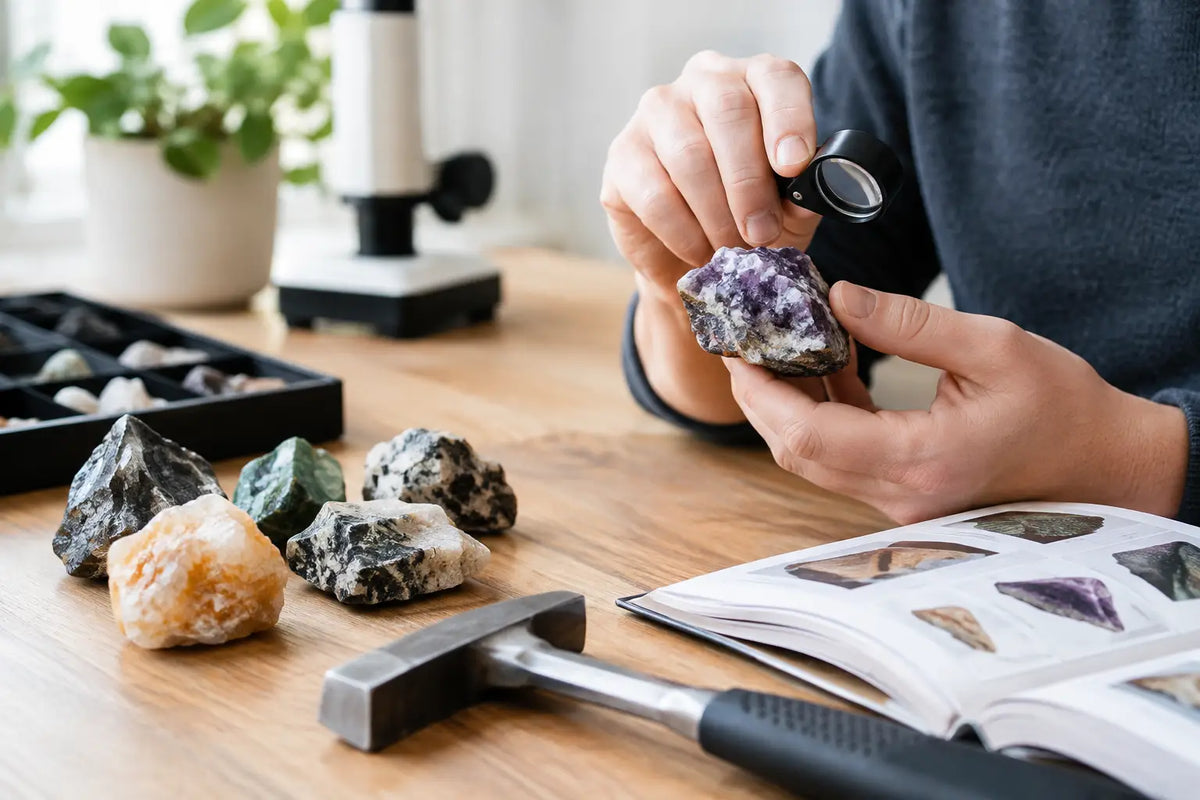
For an initial assessment, you don't need a laboratory. A good light source, a small magnifying glass, and a notebook are enough. Instead of just recording one impression, you compare several properties with one another. Only their interplay leads to a plausible identification.
Color, Transparency, and Luster
Describe color as specifically as possible: lavender rather than simply purple, moss green rather than just green, milky white rather than white. Also pay attention to the luster. Quartz can shine glassy, hematite more metallic, raw crystals sometimes dull or earthy. A waxy luster, in turn, can point to entirely different mineral groups.
Transparency is equally informative. Hold the stone against bright light. If light shines through but no clear contours become visible, it is translucent. With clear rock crystals, edges or text behind them are often recognizable. This observation helps you narrow down candidates, but never replaces looking at the other characteristics.
Crystal Form, Cleavage, and Fracture
Some minerals break irregularly and conchoidally, others can be cleanly split along certain planes. Calcite often shows clear cleavage planes, while quartz typically shows a conchoidal fracture. This property is very helpful, but not for valuable favorite pieces: deliberately breaking a stone just to identify it would be a shame.
Instead, look at edges that are already present. If they appear flat and repeatedly similar, this can indicate cleavage. Irregular, curved fracture surfaces suggest other structures. With crystal specimens, the outer crystal forms often provide additional clues, such as hexagonal quartz points or cubic forms in fluorite and pyrite.
Hardness and Streak Color
The Mohs hardness describes how resistant a mineral is to scratching. A fingernail is about 2 to 2.5, a copper coin about 3, and glass about 5.5. Very soft gypsum can be carefully scratched with a fingernail, quartz should be able to scratch glass. But caution: scratch tests can damage surfaces and reduce the luster of polished stones. Use them only on inconspicuous rough spots and never on pieces that are particularly valuable to you.
The streak color is the color of the mineral powder on an unglazed porcelain plate. It can be surprisingly different from the visible surface. Hematite appears silvery-black but often leaves a reddish-brown streak. For light-colored, hard, or transparent minerals, the test is less conclusive. Here too: a single result doesn't decide everything.
Weight, Temperature, and Magnetism
Compare stones of similar size in your hand. If a piece feels unexpectedly heavy, this can indicate a higher density. Barite or galena, for example, feel noticeably heavier than their volume would suggest. Glass, synthetic resin, and many plastic imitations, on the other hand, often feel lighter or have a less natural temperature.
A small magnet can show a reaction with certain iron-containing minerals. This is an exciting additional test, but not a general proof of authenticity. Magnetite reacts strongly, hematite varies depending on its composition. If your stone remains non-magnetic, this simply says nothing about most minerals.
Avoiding Mix-Ups Without Losing the Joy
Beginners frequently encounter dyed agate, glass, synthetic resin, or composite materials. That doesn't automatically make these pieces worthless as decoration or jewelry. Transparency is key: those who know what they're holding can choose consciously - as a colorful accessory, as a gift, or as a genuine collector's mineral.
Very intense, even colors can be a sign of dyeing, especially if they collect in cracks or drill holes. Air bubbles in supposed crystals often indicate glass. A perfect, repeated pattern can indicate a reproduction. Still, there are also natural stones with intense colors and regular crystal faces. That's why skepticism is sensible, but hasty judgment is not.
With trade names, a second look is worthwhile. Some names actually designate a mineral species, others a variety, a rock, or a creatively chosen sales name. A mineral consists of a clearly defined chemical composition and crystal structure. A rock like granite, by contrast, is composed of several minerals. This distinction brings surprisingly much order to your own collection.
How to Develop a Good Eye
Don't start with a hundred types of stone at once. Instead, choose a small group that differs clearly: rock crystal, amethyst, rose quartz, pyrite, fluorite, and selenite offer different colors, types of luster, shapes, and hardnesses. Lay them side by side, describe them in your own words, and then check reference information. Comparison trains the eye faster than pure memorization.
A collection journal is helpful. Note the name, suspected mineral group, locality or origin information, purchase date, size, special features, and open questions. Add photos taken in daylight. After a few weeks, you'll recognize patterns: perhaps your various types of quartz differ much more clearly in transparency and inclusions than you initially thought.
A magnifying glass with tenfold magnification is the most useful purchase for many beginners. It shows fine crystal faces, inclusions, grain, and possible processing traces. For precise analyses of chemical composition or crystal systems, however, professional methods are needed. For rare, high-priced, or inherited pieces, expert appraisal is the better choice over a test at home.
Authenticity, Origin, and Personal Meaning
A genuine natural stone doesn't have to be perfect. It's precisely its small peculiarities that remind us it formed over a long time inside the earth. When buying, ask about the mineral designation, known treatments, and - if available - origin or locality. Especially with collector's pieces, this information builds trust and deepens the connection to the stone.
Those who attribute an energetic or symbolic meaning to crystals may combine this level with mineralogical curiosity. The traditional meanings do not replace scientific identification or medical advice. But they can enrich a personal mindfulness practice: a rose quartz as a reminder of self-care, a rock crystal as a clear focus on the desk, or an amethyst as a calm companion in a consciously designed corner.
At Crystal Paradise, you'll find handpicked one-of-a-kind natural pieces where beauty and traceable designation go hand in hand. Use descriptions not just as a buying aid, but as an invitation to look more closely and appreciate the uniqueness of each piece.
With every stone you compare, your eye becomes more confident. Take your time, write down questions, and allow even an initially unknown find to keep a secret. It's precisely this curious patience that turns initial interest into a collection with history, feeling, and a genuine connection to nature.


Leave a comment
This site is protected by hCaptcha and the hCaptcha Privacy Policy and Terms of Service apply.