

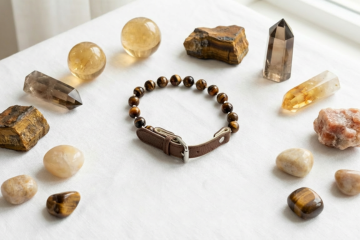


Safely Displaying a Mineral Specimen at Home
Safely setting up a mineral specimen at home means giving its natural beauty the place it deserves - without wobbly shelves, pressure marks on wood, or an uneasy feeling around children and pets. Because a specimen is not an off-the-shelf decor object. It is a unique piece of earth history: sometimes surprisingly heavy, often delicate, and as individual through its crystal faces as its energy.
Especially large amethyst geodes, clear quartz specimens, pyrite formations, or pieces with fine points only truly feel powerful once they are presented calmly, securely, and intentionally. With a few simple decisions, you create a place where your unique piece of nature can shine and stays protected for the long term.
Safely setting up a mineral specimen at home: The right location
Before you think about mats, mounts, or orientation, check the location. The most important question is not: Where does the specimen look best? But rather: Where does it stay safe in everyday life? A windowsill, a narrow dresser, or the top open shelf may be visually appealing, but they are not suitable for every mineral.
Choose a surface that is level, stable, and deep enough. The entire base of the specimen should rest flat - not just two edges or a single point. For a formation that grew at an angle, it can make sense to place the specimen slightly turned so its natural center of gravity lies centered over the stand surface. Don't rely on first impressions: press very carefully with a flat hand on different sides. If the piece tips or wobbles, it needs a different position or a stabilizing base.
You should be especially careful if children or pets live in the household. Heavy mineral specimens do not belong on table edges, low side tables, or anywhere a wagging tail, a vacuum cord, or a playing child can reach them. A closed display cabinet or a taller, load-bearing piece of furniture is often the better solution - because then you can enjoy your favorite piece with peace of mind.
Doors and hallways are also not good spots. Vibrations, drafts, passing bags, or accidental touches can cause damage there faster than one might expect. Give your specimen some distance from the lively hustle of daily life. This not only feels safer but also lets its presence in the room grow stronger.
Honestly assessing load-bearing capacity and weight
Minerals sometimes look lighter than they are. A compact pyrite specimen, a quartz cluster, or an agate formation can weigh many times what its size suggests. So always check whether the shelf, wall mount, sideboard, or display cabinet is suitable for the weight. Thin glass shelves, light hanging shelves, and unstable vintage furniture are usually not a good choice for large pieces.
With a heavy specimen, it's not just the furniture's maximum load capacity that matters. The distribution of weight matters too. Place the mineral as close as possible to a load-bearing side wall or above a vertical support of the shelf, not in the middle of a long, sagging board. On a dresser, a spot further back is usually more stable than right at the front edge.
When transporting your piece, always lift it with both hands at the solid base. Crystal points, fine edges, and protruding sections are not handles. For especially large unique natural pieces, it's wise to carry them with two people. This protects your hands, the floor, and most of all, the unique formation.
The right base protects furniture and mineral
A good base evens out small unevenness, prevents scratches on crystal and furniture, and significantly reduces the risk of slipping. It should be stable, not shed fibers, not retain moisture, and match the specimen in color. Felt pads, thin cork sheets, or a cut-to-size anti-slip mat are a practical choice for many pieces.
For an elegant, calm presentation, wooden pedestals or natural stone plates also work well. However, make sure the surface is truly level and that the pedestal can bear the weight. A heavy specimen on a pedestal that's too small looks dramatic, but it isn't a secure setup. The pedestal may well be a bit larger than the mineral's base - this creates visual space and, practically, an extra protective margin.
A base is especially valuable for sensitive furniture surfaces. Rough matrix, sharp-edged crystals, or mineral deposits can damage lacquer, glass, and wood. If you're unsure, first place a clean, soft cloth under the piece and observe how it rests. For permanent display, you should then choose a more solid solution.
For spheres, points, and irregular shapes
Not every mineral shape stands securely on its own. Spheres need a suitable ring stand that holds them firmly enough without squeezing them. Points and obelisks should stand on a level surface and must not wobble. For irregular specimens, a flat acrylic stand or an individually chosen pedestal can help make the natural display side visible.
It's important to note: a stand does not replace a stable base. It must not force a specimen into an unnatural tilt and should remain as discreet as possible. The formation itself is nature's personal masterpiece - the mount only has the task of accompanying it safely.
Choosing light, heat, and humidity consciously
Sunlight makes crystals sparkle, but direct midday sun isn't always ideal. Some minerals can lose color intensity under long, intense UV exposure. Amethyst, fluorite, kunzite, or some delicately colored quartz varieties often feel more at home in a bright spot with indirect light than directly behind a sunny window.
Radiators, fireplaces, and permanently humid rooms also require a sensitive touch. Strong temperature fluctuations can stress sensitive minerals, while humidity can alter metal content or certain mineral surfaces. A bathroom is therefore only a good location if it's well ventilated and the specimen isn't constantly exposed to water vapor.
Energetically, you're free to choose your location purely for yourself. Some people deliberately place a clear quartz specimen in the living area to invite clarity and lightness into the room. Amethyst is often valued as a calm companion in the bedroom or a retreat space. What matters is that the place feels right to you - and that the practical conditions are right as well.
How to check the setup before the first moment of wonder
After setting it up, take a minute for a safety check. Especially with a new piece of furniture or a freshly arranged crystal corner, this small moment of mindfulness is worthwhile.
- The specimen rests fully on its load-bearing base on the surface.
- It doesn't wobble when you touch it very lightly from the side.
- The shelf, table, or display cabinet doesn't appear warped or unstable under the weight.
- Crystal points don't protrude into walkways or dangerous edges.
- Children, pets, and cleaning equipment cannot easily reach the piece.
Cleaning without risk to fine crystals
When cleaning, less is often more. Dust is best removed with a soft, dry brush or a gentle microfiber cloth. For rugged specimens, a soft cosmetic brush helps reach between crystal points and into small cavities. Don't rub hard over shiny surfaces and avoid stiff brushes.
Water isn't the right choice for every mineral. Some pieces are sensitive to moisture or contain inclusions and metallic minerals that can change. If you don't know the exact care properties of your specimen, clean it dry. Incense or sound can also be lovely personal rituals without directly stressing the surface.
Never grip a specimen by its points, always by its solid base. When cleaning, lay a thick towel on the table in case you need to move it. This way, care becomes not a risky moment but a calm encounter with your unique piece of nature.
A handpicked mineral specimen from Crystal Paradise can be more than a beautiful eye-catcher: an anchor for your spaces, your rituals, and your joy in genuine nature. Give it a safe place that respects its form. Then there's enough room left for what truly matters when looking at a special crystal - a brief moment to pause.


Leave a comment
This site is protected by hCaptcha and the hCaptcha Privacy Policy and Terms of Service apply.