

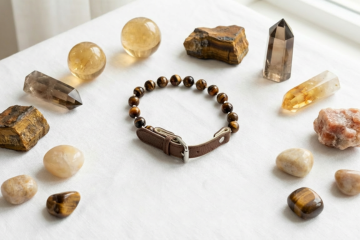


Article: Crystal Zodiac Gemini (May 21 – June 21)

Crystal Zodiac Gemini (May 21 – June 21)
Healing Stones Gemini: Two Mineral Groups for One Double Sign

Which healing stones suit Gemini? People with the zodiac sign Gemini (May 21 – June 21) are associated in astrological stone healing with clear, bright stones. Gemini is the second air sign and is astrologically assigned to Mercury. In the CRYSTAL ZODIAC Gemini Collection you'll find the stones of this sign – and with no other sign does the selection split so clearly into two halves.
The Zodiac Sign Gemini: Element, Ruler, Profile
Gemini is an air sign and a mutable sign – it stands at the end of spring, just before the summer solstice. Astrologically it is considered a sign of exchange, curiosity, and adaptability.
In the stone assignment, a peculiarity emerges that is rarely seen so clearly: The stones assigned to Gemini split into two mineralogically completely opposite groups. On one side the quartzes – rock crystal and citrine, hard, unsusceptible, suitable for everyday use. On the other side apophyllite and celestine: soft, cleavable, water-shy. For a double sign, this is a fitting coincidence, even though it is purely mineralogical chance.
The Stones of Gemini in Our Knowledge Base
Our healing stone database assigns eight stones to Gemini: Apophyllite, Bentonite, Rock Crystal, Blue Apatite, Celestine, Citrine, Sodalite, and Topaz. We carry six of them, and all six are in the collection.
Rock Crystal and Citrine – the Robust Half
Both are quartz: SiO₂, trigonal, Mohs hardness 7, no cleavage. The difference lies solely in traces of iron that color the citrine yellow. It hardly gets more robust than this – these two tolerate water, sun, and everyday life in a pocket.
With citrine, a closer look is worthwhile: A large portion of the trade material is heat-treated amethyst. You can find out how to tell the difference in How to Recognize Real Citrine. For the Citrine Selection and the Rock Crystal Selection.
Apophyllite – and the Company It Grows In
Apophyllite is a phyllosilicate, KCa₄[F|(Si₄O₁₀)₂]·8H₂O, tetragonal, Mohs hardness 4.5 to 5, with perfect basal cleavage. The eight water molecules in the formula are the reason for its name: when heated, they escape, and the surface flakes off.
More interesting is where it comes from. Our specimens almost all come from India – from the cavities of the Deccan Basalt, one of the largest flood basalt provinces on Earth. There, apophyllite doesn't grow alone, but together with other zeolites and zeolite-like minerals: Stilbite, Okenite, and Thomsonite. That's why these exact names also appear in our Gemini collection – they sit on the same specimens. For the Apophyllite Selection.
Celestine – Soft Blue and Quite Sensitive
Celestine (also Coelestine) is strontium sulfate, SrSO₄, orthorhombic, Mohs hardness 3 to 3.5, perfect basal cleavage. The soft blue crystal geodes look solid but are so soft that even a fingernail leaves marks. Our pieces come from Madagascar. For the Celestine Selection.
Sodalite and Topaz
Sodalite is a deep blue framework silicate, Mohs hardness 5.5 to 6; it is often confused with Lapis Lazuli – the simplest difference is the golden pyrite flecks that only lapis has. For the Sodalite Selection.
Topaz is, with Mohs hardness 8, the hardest stone of the sign – and yet the trickiest to handle, because it has perfect basal cleavage. A hard stone that splits along a plane if loaded incorrectly. We carry it only in small numbers.
Bentonite and Blue Apatite
These two are in the assignment, but we don't have them available. We mention them anyway – a list that only reflects one's own inventory isn't an assignment, it's a catalog. Bentonite, by the way, is not a gemstone but a clay rock made of weathered volcanic ash; it appears in stone lists, but is practically never found as a piece in trade.
What's Currently in the Gemini Collection
The collection comprises 82 active pieces and shows all six Gemini stones we carry: Citrine (20), Rock Crystal (20), Apophyllite (20), Celestine (13), Sodalite (6), and Topaz (3). In addition there is Stilbite, Okenite, Thomsonite, and a few other minerals that come along as companions on the same Indian specimens.
The origin clearly reflects this: India (26) for the apophyllite company, Madagascar (12) for the celestine, Brazil (11) and China (10) for the quartzes. 33 of the 82 pieces are one-of-a-kind, the price range goes up to 490 euros.
Care: The Two Halves Need Two Rules
| Stone | Mohs Hardness | Water |
|---|---|---|
| Topaz | 8 | not suitable |
| Rock Crystal | 7 | suitable |
| Citrine | 7 | suitable |
| Sodalite | 5.5 – 6 | conditionally |
| Apophyllite | 4.5 – 5 | not suitable |
| Celestine | 3 – 3.5 | not suitable |
Rock crystal and citrine may briefly go under lukewarm water and then be dried off. Everything else should be cleaned dry – for apophyllite and celestine, best with just a soft brush, because a cloth catches on the crystal points.
Two things that matter especially with this sign: Apophyllite specimens do not belong in direct sunlight – heat drives out the crystal water and the surface becomes dull. And do not store together: A rock crystal next to a celestine geode will scratch it within a drawer. The complete system is in Water Stones – Which Gemstones Are Safe.
Frequently Asked Questions
Which healing stones suit the zodiac sign Gemini?
Our healing stone database assigns eight stones to Gemini: Apophyllite, Bentonite, Rock Crystal, Blue Apatite, Celestine, Citrine, Sodalite, and Topaz. We carry six of them, and all six are in the Gemini collection – we don't have Bentonite and Blue Apatite. Rock crystal and citrine are the robust representatives, apophyllite and celestine the sensitive ones.
Why are Stilbite, Okenite, and Thomsonite in the Gemini collection?
Because they grow together with the apophyllite. Our apophyllite specimens come from the cavities of the Deccan Basalt in India, and there zeolites and zeolite-like minerals form in company: Stilbite, Okenite, and Thomsonite often sit on the same specimen. So they are not specifically assigned, but come along as companions.
Which Gemini stone tolerates water?
Rock crystal and citrine – both are quartz with Mohs hardness 7 and no cleavage. We classify sodalite as conditionally suitable, meaning only polished or tumbled pieces and only briefly. Apophyllite, celestine, and topaz do not belong in water; for apophyllite and celestine it's due to the softness and perfect cleavage, for topaz solely due to the cleavage.
Why is apophyllite called that?
The name comes from Greek and roughly means "to flake off." In the crystal structure sit eight water molecules per formula unit; when the crystal is heated, they escape, and the surface flakes off. For the same reason, apophyllite specimens belong neither in water nor in direct sunlight.
Are the effects of healing stones scientifically proven?
No. The assignments described stem from spiritual and cultural traditions and have no scientific evidence. What can be substantiated, however, are the mineralogical properties – hardness, formula, crystal system, locality. Reliable information can be found at the Mineralienatlas or at Mindat.org.
Which other air signs have similar assignments to Gemini?
Libra and Aquarius are the two other air signs. With Aquarius, Gemini shares apophyllite – it is in the assignment for both. With Libra there is no overlap: Amazonite, Howlite, Jade, Lepidolite, Magnesite, Rose Quartz, and Snowflake Obsidian are assigned to it.
Note: The effects and assignments mentioned are spiritual traditions without scientific evidence. They do not replace medical or therapeutic advice.

Written by Christian Neumayer


Leave a comment
This site is protected by hCaptcha and the hCaptcha Privacy Policy and Terms of Service apply.